How to Read Fragrance Case Studies Before You Trust Them
A case study page is a portfolio of decisions, not a scoreboard. Read two projects side by side and the useful question is not which sounds more impressive but which one resembles your project in volume, format, market and regulatory load. A supplier that performs well on a small luxury fine fragrance launch may still be the wrong partner for a thirty-SKU home fragrance range.
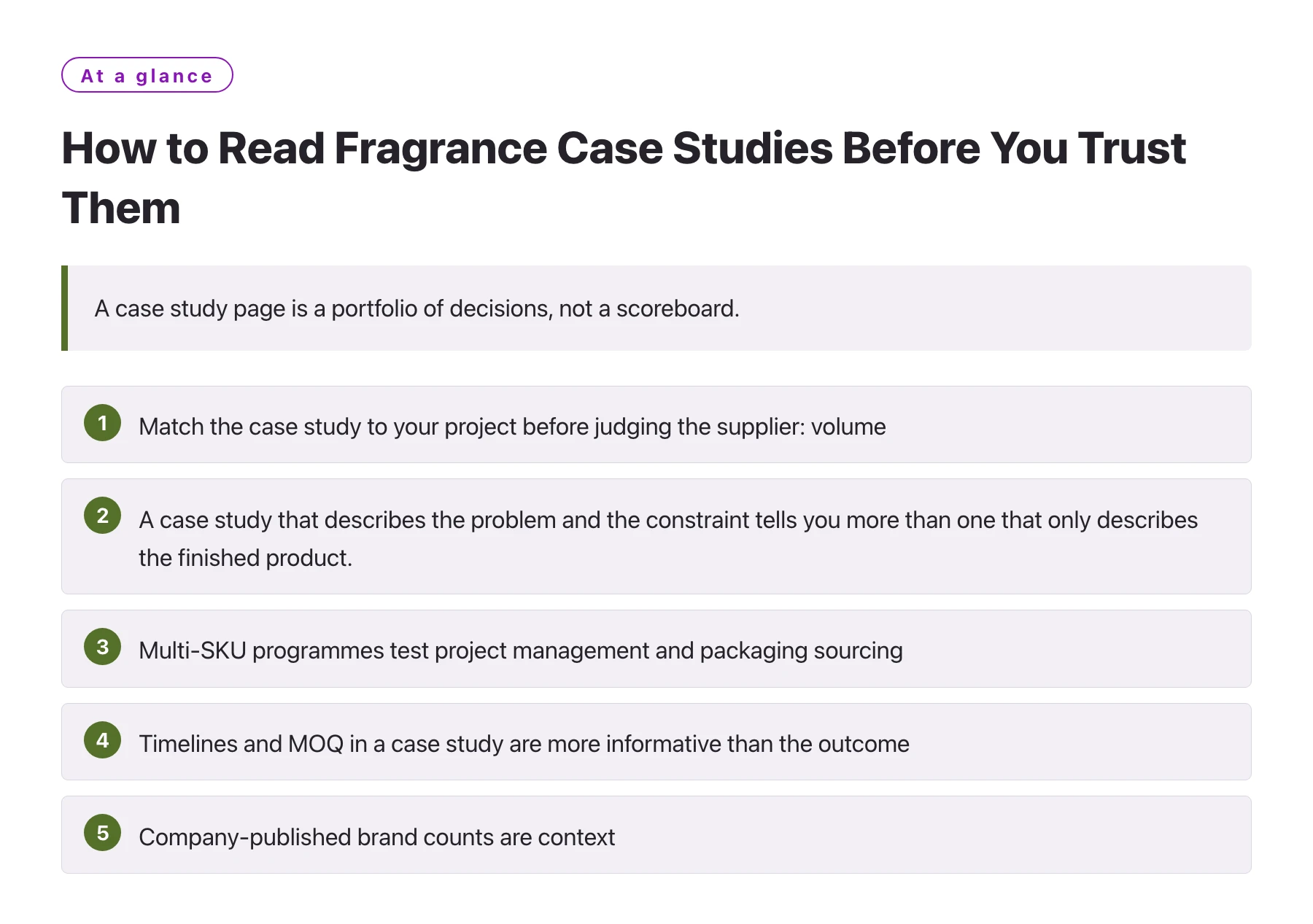
Key takeaways
- Match the case study to your project before judging the supplier: volume, format, channel and regulatory load decide whether the experience transfers.
- A case study that describes the problem and the constraint tells you more than one that only describes the finished product.
- Multi-SKU programmes test project management and packaging sourcing; single-hero launches test development depth and finish quality.
- Timelines and MOQ in a case study are more informative than the outcome, because they show the shape of the work rather than its marketing.
- Company-published brand counts are context, not evidence; treat them as positioning until you can verify the parts you care about.
Buyers often arrive at a supplier's case study page late in the process, after a shortlist has formed, and read it as confirmation. It is far more useful earlier, as a filter. The comparison below is deliberately structural rather than promotional.
Two project archetypes are used throughout. Neither is a specific client; they are patterns that appear repeatedly in fragrance manufacturing portfolios, and the point is to show what each pattern rewards.
Project A versus Project B: what each one actually tests
| Dimension | Project A: multi-SKU home fragrance range | Project B: single fine fragrance launch |
|---|---|---|
| Typical brief | A family of scents that must feel related and cover a wall of shelf space | One scent that carries the whole brand story |
| Development depth | Moderate per scent, broad across the range | Deep, with more iterations on a single accord |
| Hardest part | Project management: dozens of components, one launch date | Perfumery: performance and distinctiveness in a crowded category |
| Packaging sourcing | Many containers and closures, often stock moulds | Fewer components, more custom finish and decoration |
| Regulatory load | Repeated documentation across many SKUs | One product, but often across several destination markets |
| MOQ behaviour | Component MOQs, not fragrance MOQs, usually set the constraint | Fragrance and decoration MOQs dominate |
| What it proves about a supplier | Scheduling discipline, sourcing reach, consistency | Formula quality, finishing quality, patience through iteration |
Read the column that matches your project and ignore the other one. A supplier's strength in one column says very little about its strength in the other, and portfolios rarely label which is which.
What a case study can and cannot prove
Any published project summary is written after the fact and usually by the party that did the work. That does not make it useless, but it does set the ceiling on what you can conclude.
What it can prove is the shape of a supplier's experience: which categories they have produced, which formats they handle, whether the projects involve decoration and assembly, and whether the timelines described are consistent with the lead times they quote you today. Trade press covering the beauty and personal care industry treats this category breadth as a meaningful signal of manufacturing capability [1], and it is the part of a case study that is hardest to fabricate accidentally.
It cannot prove your outcome
A finished project says nothing about how the supplier behaved when a component was late, when a test failed, or when a buyer changed the artwork. Those moments decide whether a project is pleasant, and they are almost never in the write-up. Ask for them explicitly: describe the worst moment on a recent project and what the supplier did.
It cannot prove scale that you need
A portfolio of exquisite small runs does not demonstrate that a supplier can hold a specification across a large order. Consumer research published by Mintel on beauty and personal care repeatedly shows how quickly demand can move within a category [2], which is precisely why the MOQ and repeat-order behaviour behind a case study is worth asking about directly.
Aggregate claims are context, not evidence
Some manufacturers publish totals - brands served per year, countries shipped to. Xuelei, for example, states that it serves more than 400 brands a year across over 100 countries. Treat figures like that as company-published context that frames a conversation rather than proof of fit; the scope behind the total is set out by Xuelei's manufacturing arm, and that scope is more useful to you than the headline number.
A useful exercise before a shortlist meeting: take the case study that looks most like your project and write down the five questions it does not answer. Those five questions are your agenda. Suppliers who can answer them with specifics are telling you something the page could not.
The questions a case study should make you ask
Start with the constraint. Every real project has one - a fixed retail price, a launch date tied to a season, a pack that had to be reused from an existing line, a market that required a specific test. A write-up that mentions the constraint and explains how it was solved is far more informative than one that lists the scent notes.
Then ask about the handover. Where did the compound come from, where was it filled, who made the pack, and who held the retained sample? This is the fastest way to learn whether the supplier is a manufacturer or an assembler, and it changes your risk profile either way.
Then ask what would have gone differently. A supplier willing to say that a pack choice was wrong or that a testing round was scheduled too late is describing a real process. A page of perfume OEM and ODM case studies that only contains successes is a marketing document, and it should be read as one.
Finally, and most practically, ask for the timeline in working days and the MOQ in units. If a supplier can talk you through both without leaving the room, the portfolio has substance behind it. If the answer is a referral back to the sales contact, the numbers you were quoted may not reflect the projects you just read about.
Turning a portfolio review into a decision
Once two suppliers both clear the structural test, the decisive differences are usually operational rather than creative. Who replies to a technical question within a day, who produces a written scope without being pushed, who volunteers a problem before you find it. These are observable in a single meeting and they predict the whole relationship better than any case study.
The final check is comparative. Send the same brief to both and read the responses side by side, rather than judging each on its own terms. It helps to know in advance how to compare perfume factories on paper, because the temptation is to reward the supplier whose portfolio photographs best.
Sources
- Cosmetics Business —— A trade publication covering the beauty and cosmetics industry, including fragrance launches and regulatory developments.
- Mintel Press Centre —— Mintel's press releases on consumer and beauty market research, including fragrance and personal care trend reporting.
Frequently asked questions
Are manufacturer case studies reliable?
They are reliable as a description of category experience and unreliable as a prediction of your own project. Use them to filter for relevant experience, then verify process behaviour directly.
What if a supplier has no case studies at all?
Ask for a walkthrough of two recent projects under confidentiality instead, covering scope, timeline and the problems encountered. Many capable manufacturers keep client names private, so the absence of a public page is not itself a red flag.
Should we choose a supplier that specialises in our category?
Usually, yes, because procurement and scheduling patterns differ by category. The exception is when your project is unusual for that category and needs a different strength, such as deep formulation work rather than volume production.
How much weight should we give to brands-served totals?
Treat them as context rather than proof. A large total does not tell you whether the supplier is a good fit for your volume, format and market, which are the variables that decide the outcome.
What is the fastest way to compare two shortlisted suppliers?
Send an identical complete brief and compare the written responses line by line, including what each one asks you for. The questions a supplier asks reveal more about process than the answers it gives.