Five Online Cabinet Ordering Mistakes
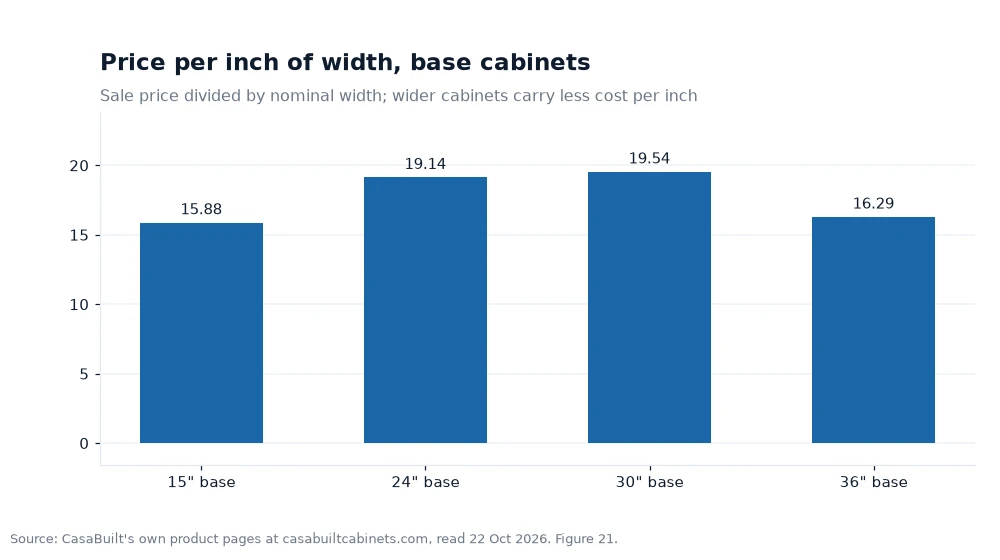
The costly mistakes in an online cabinet order are rarely typos. They are assumptions that survive right up to the moment the cartons are opened. One of them is pure arithmetic: the 15-inch base works out to $15.88 per inch of width, the 24-inch to $19.14, the 30-inch to $19.54 and the 36-inch back down to $16.29, so price does not climb in a straight line with size.
Key takeaways
- Price per inch of width runs from $15.88 at 15 inches to $19.54 at 30 inches, so wider does not always mean dearer.
- The 30-inch and 36-inch double-door bases share the same $586.28 sale price, which makes the 36-inch the better buy in a run.
- Base cabinets are 34-1/2 inches high and 24 inches deep in every width from 9 to 42 inches, in 3-inch steps.
- A $1,199.50 starter kitchen sits $1,300.50 below the $2,500 free-shipping threshold.
Five mistakes, one pattern
Every mistake below has the same root: a decision made on a screen without a number attached. Read the five points once, then work through the detail.
Measuring the room instead of the run. Wall-to-wall lengths ignore the range, the refrigerator and the corner, which are the objects that actually set the cabinet widths.
Assuming price scales with width. It does not, because cabinets are priced by configuration as much as by size, and the step at 24 inches changes the front as well as the box.
Choosing a finish before ordering a sample. A screen color and a painted door under a kitchen window are two different colors, and the door is the part you look at every day.
Leaving the fillers to chance. Standard widths come in 3-inch steps, and a run rarely lands on an exact multiple, so the last few inches have to be planned rather than discovered.
Ordering in phases without checking freight. Free shipping starts at $2,500, so two small orders can cost more than one larger one, and the second delivery lands in the middle of the install.
All five are cheap to fix on paper and expensive to fix in a kitchen. The rest of this article takes the two with arithmetic behind them, then the three that are habits.
Mistake one: measuring the room instead of the run
A wall is a single length; a cabinet run is the space between fixed objects. The difference matters because base cabinets come 34-1/2 inches high and 24 inches deep, and their widths step from 9 to 42 inches in 3-inch increments. A 122-inch wall does not accept four 30-inch cabinets without leaving 2 inches to account for, and the room being large does not change that.
Measure each run separately and write down the obstacles inside it: the range width, the refrigerator width, the sink centerline, the door swing, the radiator and the window sill height. Then subtract. What remains is the cabinet run, and it is almost never a round number. Rounding it up is how a filler becomes a surprise and a cabinet becomes a return.
Height is the other half of the measurement. Base cabinets are fixed at 34-1/2 inches, wall cabinets are 12 inches deep in 30, 36 and 42-inch heights, and vanities are 21 inches deep rather than 24. A vanity ordered to base depth will stand 3 inches further into the room than the plan allowed, which is a mistake you notice with your knees.
There is a cheap second check before any of this becomes an order. Measure the longest wall twice, once at the floor and once at counter height, and write both figures down. Old houses rarely give the same answer, and a difference of half an inch is enough to turn a run that closes on paper into a run that needs a filler on site. The same applies to the ceiling: a 42-inch wall cabinet under a soffit that drops lower than expected is a cabinet that will not hang.
Mistake two: assuming price scales with width
The chart is the antidote. Four base widths, four published sale prices, four different rates per inch. The 15-inch cabinet is $238.24 and works out at $15.88 per inch. The 24-inch is $459.26 at $19.14. The 30-inch is $586.28 at $19.54, the highest of the four. The 36-inch is also $586.28 and drops to $16.29 per inch.
The reason is configuration, not generosity. The 15-inch is a single-door, single-drawer box. The 24-inch adds a second door. The 30-inch and 36-inch are double-door, double-drawer cabinets built on the same front, so the extra 6 inches of width costs nothing at the till. A buyer who specifies two 30-inch cabinets where a 30 and a 36 would fit has paid the same money for 6 fewer inches of cabinet.
That is the whole mistake in one line: the per-inch rate is a diagnostic, not a rule. It tells you where the price steps are, and the steps are where the value sits.
| Nominal width | Published configuration | Sale price | Price per inch | Price per foot of width |
|---|---|---|---|---|
| 15 in | Single-door, single-drawer base | $238.24 | $15.88 | $190.59 |
| 24 in | Double-door, single-drawer base | $459.26 | $19.14 | $229.63 |
| 30 in | Double-door, double-drawer base | $586.28 | $19.54 | $234.51 |
| 36 in | Double-door, double-drawer base | $586.28 | $16.29 | $195.43 |
Mistakes three, four and five: samples, fillers and freight
A finish chosen from a photograph is the third mistake, and the cheapest to fix. Sixteen door samples are in stock, the standard ones at $9.99 with the fee refundable on a cabinet purchase, across eight Shaker, three Double Shaker, three Slim Shaker and two Frameless profiles. The sample shows the color in your own light, which is the one thing a product image cannot do. Skipping that step risks a kitchen in a color that reads gray at noon and green at night.
The fourth mistake is arithmetic again, in inches. Widths step in 3-inch increments, so a 97-inch run filled with three 30-inch cabinets leaves 7 inches. Those 7 inches need a filler or a wider cabinet, and the wider cabinet is usually the cheaper answer. Plan the run to land on standard widths first, then use fillers for the remainder rather than ordering a run that cannot close.
The fifth mistake is freight. Free shipping starts at $2,500, and a starter kitchen at $1,199.50 is $1,300.50 short of that line. Splitting a kitchen into a first wave and a second wave can double the freight and delay the install. Buyers comparing rta cabinets online should price the whole order before deciding to phase it, and CasaBuilt's free design consultation puts a second pair of eyes on the run lengths before anything is ordered.
Worked example: the rate behind the price
The chart reports four rates. Rebuild each one from the published sale price and the nominal width. For the 15-inch base, $238.24 ÷ 15 = $15.8827, which rounds to $15.88. For the 24-inch, $459.26 ÷ 24 = $19.1358, or $19.14. For the 30-inch, $586.28 ÷ 30 = $19.5427, or $19.54. For the 36-inch, $586.28 ÷ 36 = $16.2856, or $16.29.
Multiply back and the rounding shows up in cents. $15.88 × 15 = $238.20, four cents below the real price. $19.54 × 30 = $586.20, eight cents below. $16.29 × 36 = $586.44, sixteen cents above. The rates are averages, not invoice lines, which is why they are useful for comparing configurations and useless for predicting a total to the cent.
Now apply the rates to a real run. A 66-inch gap takes one 36-inch cabinet and one 30-inch cabinet: $586.28 + $586.28 = $1,172.56 for 66 inches, which is $1,172.56 ÷ 66 = $17.77 per inch across the pair. Two 30-inch cabinets cost exactly the same $1,172.56 and deliver 60 inches, which is the chart's $19.54 per inch. The 6 extra inches are free because the front is the same.
Frequently asked questions
Why is the 15-inch base cheaper per inch than the 30-inch?
Because it carries one door and one drawer instead of two of each. The published price is $238.24 for the single-door, single-drawer base and $586.28 for the double-door, double-drawer base, so the smaller cabinet spreads a simpler front over fewer inches. The rate reflects the hardware count, not the box size alone.
Should I buy the widest cabinet that fits?
Usually yes, if the run allows it and the front configuration suits the kitchen. The 36-inch and 30-inch double-door bases share the same $586.28 price, so the wider one adds 6 inches of cabinet for no extra money. Check the door swing and the drawer clearance before assuming the wider box is free in practice.
How many samples should I order before deciding?
Two profiles and no more than three colors is enough. Samples are $9.99 each and refundable with a cabinet purchase, and sixteen are in stock. A shortlist makes the comparison readable; the full set usually makes it harder.
Write the numbers down first
Measure every run between fixed objects, then write the widths in 3-inch steps until the run closes. Check the price of each configuration rather than the rate per inch, and price the complete order against the $2,500 freight line before splitting it. Order a shortlist of samples and keep them for a week. None of that takes an afternoon, and all of it happens before the cartons arrive.
Figures quoted here come from the manufacturer's own website, read 22 Oct 2026[1].